Issue #5: The Healing Power of Sound · Current Issue
Free article
Which Sound Healing Instrument Are You Drawn To?
A mini-guide to bowls, gongs, drums, tuning forks, chimes, and voice.
By Dr. Constance Santego
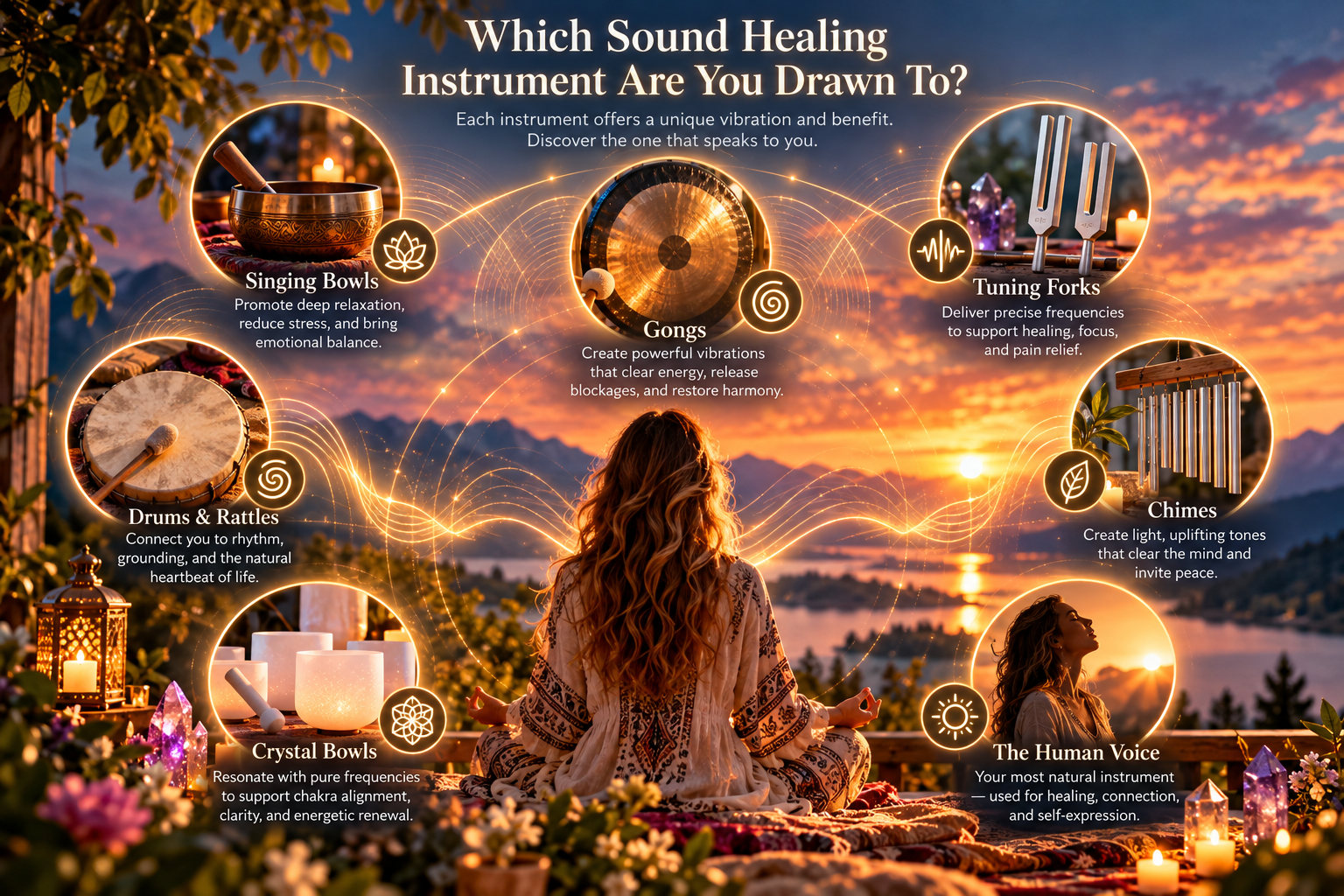
Your sound preferences are individual, and a relaxing moment is a subjective experience, not medical evidence. Use this guide to explore instruments safely without relying on healing frequency claims.
Choosing a sound-healing instrument should be based on your own comfort and preferences rather than promises of health benefits. Use this guide to explore sounds that feel pleasant and neutral while maintaining personal boundaries.
Choosing a sound-healing instrument can feel a little like choosing a landscape: some people want a soft horizon, others a dramatic storm, and plenty prefer to keep the volume low and the exit nearby. For The Frequency Within, consider this a guide to your sound preferences—not a promise that an instrument or a particular frequency will treat a health condition. People’s responses are individual, and a pleasing or relaxing moment is a subjective experience, not medical evidence.
Start with a few questions: Do you like a clear note or a layered wash? A steady pulse or an unpredictable shimmer? Is vibration interesting, or too much? Are you comfortable with sudden, loud sounds? Your answers can lead you toward an instrument—or toward silence, which is also a perfectly good choice.
### If you like a clear, lingering note: bowls
Singing bowls, including metal bowls and crystal bowls, can produce sustained tones that shift in texture as they ring. A single, softly played note may appeal if you enjoy listening to a sound fade, or noticing a gentle vibration nearby. Bowls vary widely in pitch, loudness, and timbre, so ask to hear one at a comfortable distance before a session. If you’re sensitive to bright or ringing sounds, choose a lower volume, stay farther away, or skip it. “Bowl” covers instruments with different materials and histories; it isn’t one universal tradition or technique.
### If you enjoy a big, changing sound: gongs
A gong can move from a subtle shimmer to a broad, complex swell. If you like music that unfolds rather than repeating the same note, this may intrigue you. But gongs can become very loud, and their layered overtones may feel intense or hard to predict. Ask about the expected volume and whether the player can keep it gentle. Sit near an exit, use hearing protection if appropriate, or choose not to attend if you’re unsure. Gongs have distinct histories and uses across cultures and musical settings; a modern sound session isn’t interchangeable with those contexts.
### If rhythm feels grounding: drums
Drums offer a pulse you can feel as much as hear. A soft, even beat may suit listeners who like repetition and a clear rhythmic shape; a faster or louder pattern can feel energizing—or overwhelming. Try a few quiet beats at a distance before joining in. Notice whether the rhythm feels comfortable in your body, and remember that you don’t have to match it or participate. Drumming traditions are numerous and culturally specific; instruments and rhythms carry meanings beyond their use in contemporary wellness spaces.
### If precision appeals: tuning forks
A tuning fork produces a relatively clear tone when struck, and some are designed to resonate at particular pitches. You might enjoy the simplicity of one note, especially if dense soundscapes aren’t for you. Ask the practitioner to demonstrate it away from your ears and body first; don’t allow a fork to be struck close to your head or placed on you without clear discussion and consent. Claims that a specific pitch or frequency cures illness aren’t established by the sound itself. A tuning fork can be an interesting acoustic object without being a treatment.
### If you want a brief sparkle: chimes
Chimes often make delicate, high notes that arrive in irregular patterns. They can be a lovely choice if you like light, airy sounds and small surprises. That same brightness can bother people with sound sensitivity, tinnitus, or a preference for low tones. Ask for a very gentle demonstration, at a distance, and see how it lands. A short sample tells you more than a description does.
### If you want a sound you can shape: voice
Voice may be the most personal option: humming, vowel sounds, or simple singing can be adjusted moment by moment. You control the volume and can stop immediately. Try a quiet “mmm” or an easy vowel without pushing your breath; natural breathing matters more than sustaining a note. You can also listen rather than sing. Voices and vocal practices are part of many cultural and spiritual traditions, each with its own setting and meaning, so approach unfamiliar practices with curiosity and respect.
### Pick your own route
For one clear tone, sample a bowl or tuning fork. For a shifting soundscape, ask about a gong at low volume. For pulse, try a few gentle drumbeats; for a light shimmer, listen to chimes from across the room. If choice and control matter most, begin with your own soft voice—or simply listen to the room.
Before booking or trying an instrument, ask how loud it gets, whether sounds may be sudden, how long they last, and whether you can sit farther away, step out, or opt out. A responsible practitioner should welcome those questions and respect your boundaries. If you notice discomfort, cover your ears, move away, or leave; there’s no need to endure a sound to get anything “right.”
Let preference—not a claim about healing frequencies—guide the experiment. The useful question may be as simple as: Which sound feels pleasant, neutral, or too much for me today? Your answer can change from one day to the next. Within this little listening map, comfort is not a side note; it’s the compass.