Issue #6: The Wisdom Within the Stones · Current Issue
Free article
Soleus: The Muscle That Keeps You Grounded
By Dr. Constance Santego
You probably don't think about your soleus very often.
You probably don't think about your soleus very often.
You may not even know exactly where it is.
But every time you stand, walk, climb stairs or quietly balance on your feet, this deep calf muscle is working behind the scenes.
It isn't flashy.
It doesn't get the attention of larger muscles.
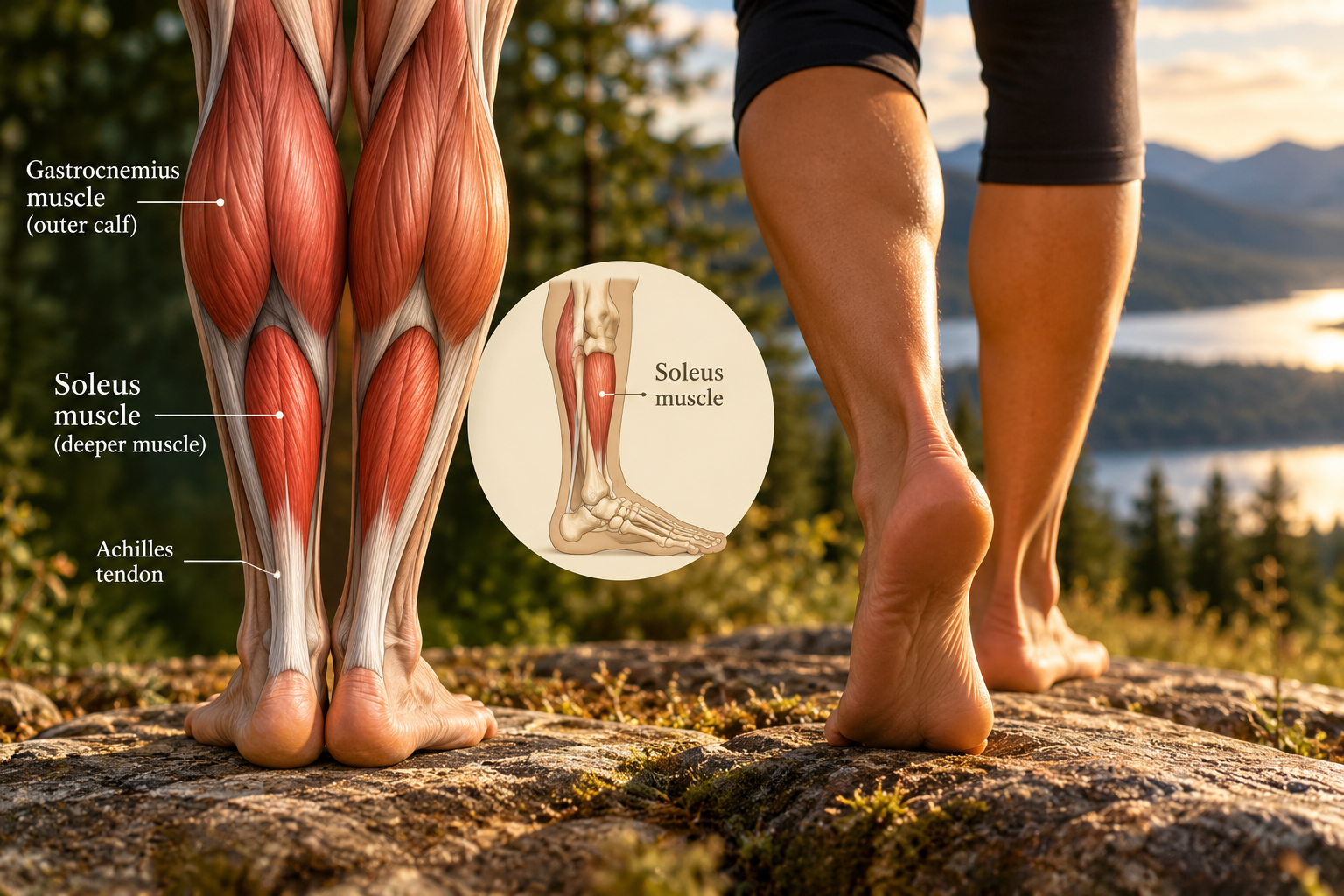
And much of it is hidden beneath the gastrocnemius—the prominent calf muscle you can easily see.
Yet the soleus plays an essential role in something we do every day:
staying upright.
For an issue devoted to grounding, Earth and the wisdom within the stones, there could hardly be a more appropriate Muscle of the Month.
Because before grounding becomes a metaphor, it is something beautifully physical.
Your body meets the Earth through your feet—and your soleus helps keep you there.
---
## Meet the Soleus
The soleus is a broad, flat muscle located in the posterior lower leg.
Together with the gastrocnemius, it forms much of the muscular mass we commonly call the calf.
But the two muscles aren't identical.
The gastrocnemius is the more superficial muscle—the one responsible for much of the visible contour of the calf.
The soleus lies deeper.
The gastrocnemius crosses both the knee and ankle joints.
The soleus does not cross the knee.
Instead, it originates from portions of the tibia and fibula and joins the gastrocnemius through the powerful calcaneal—or Achilles—tendon to attach to the heel bone.
That anatomical difference becomes important when we stretch and work with the muscle.
---
## Soleus at a Glance
Location: Deep posterior calf
Origin: Posterior aspects of the tibia and fibula
Insertion: Calcaneus through the calcaneal/Achilles tendon
Primary Action: Plantarflexion of the ankle
Innervation: Tibial nerve
Main Job: Helping control the ankle during standing and movement
---
## What Does the Soleus Actually Do?
Its primary action is plantarflexion.
That's the movement that points the foot downward at the ankle.
Imagine:
pressing a gas pedal,
rising onto your toes,
pushing the ground away while walking,
or pointing your foot.
Your calf muscles are involved.
But the soleus has another particularly important role.
## It Helps Keep You Standing
Standing still isn't actually still.
Your body continuously makes tiny adjustments to keep your centre of mass over your base of support.
Without those corrections, gravity would win rather quickly.
The soleus contributes significantly to controlling forward movement of the lower leg over the foot and maintaining postural stability during quiet standing.
In other words, while you're standing there thinking you're doing nothing—
your soleus is working.
That makes it an important postural muscle.
---
## Gastrocnemius or Soleus?
These two muscles work together, so they're easy to confuse.
Here's a simple distinction.
Gastrocnemius
More superficial.
Crosses the knee and ankle.
Contributes to plantarflexion of the ankle.
Also helps flex the knee.
Often becomes more involved in powerful or explosive movements.
Soleus
Lies underneath the gastrocnemius.
Crosses the ankle but not the knee.
Plantarflexes the ankle.
Plays an important role in standing and postural control.
And here's a useful practitioner clue:
The position of the knee changes how we emphasize these muscles during stretching.
With the knee straighter, the gastrocnemius is placed under greater stretch.
Bending the knee reduces tension through the gastrocnemius and allows a calf stretch to emphasize the deeper soleus more effectively.
That is why two calf stretches that look almost identical can target the area differently.
---
## Try This: Find Your Soleus
Stand facing a wall.
Place your hands against it for support.
Step one foot slightly behind you.
Keep the heel of the back foot comfortably on the floor.
Now gently bend the back knee while allowing it to move forward slightly.
Keep the heel down.
You may feel the stretch lower and deeper in the calf than you do during the traditional straight-knee calf stretch.
Don't bounce.
Don't force the range.
You should feel a comfortable stretch—not sharp pain.
Now straighten that back knee and notice whether the sensation changes.
You've just experienced one of the easiest ways to appreciate the difference between the gastrocnemius and soleus.
---
## Why Might the Soleus Feel Tight?
Many things can contribute to calf tightness or fatigue.
Long periods of standing.
Changes in activity.
Walking or hiking more than usual.
Running.
Climbing hills or stairs.
Footwear changes.
Reduced ankle mobility.
Repetitive loading.
And sometimes what feels like "tightness" isn't something that simply needs to be stretched.
Muscles respond to the demands placed upon them.
That's why persistent pain, swelling, weakness or significant changes deserve more attention than simply reaching for a foam roller.
---
## Practitioner Note
For massage therapists, bodyworkers and movement professionals, the soleus is worth remembering precisely because it sits deep to the gastrocnemius.
Working only superficially through the calf can mean overlooking deeper tissues.
Consider the client's:
ankle mobility,
walking and activity patterns,
foot position,
knee position,
Achilles tendon region,
and the overall function of the lower leg.
When assessing calf tension, compare how the client responds with the knee extended versus flexed.
That change can help differentiate the relative contribution of the gastrocnemius and soleus.
As always, work within your professional scope and avoid treating unexplained symptoms as simply muscular.
---
## A Special Caution With Calf Pain
Calf pain isn't always muscular.
New or unexplained calf pain—particularly when accompanied by swelling, warmth, redness or skin colour changes—should not automatically be massaged or treated as a tight muscle.
Those symptoms can have causes requiring medical assessment, including a possible blood clot.
Sudden shortness of breath, chest pain, coughing up blood, fainting or other severe symptoms require urgent medical attention.
Knowing when not to massage is part of good practice.
---
## The Muscle Pump
The calf also participates in an important mechanical process sometimes described as the calf muscle pump.
When lower-leg muscles contract during movement, they help compress veins within the leg.
Along with one-way venous valves, this muscular activity helps move venous blood upward toward the heart against gravity.
The soleus is part of this system.
It's another reason regular lower-leg movement matters during long periods of sitting or standing.
The same region helping us stand against gravity also helps the circulatory system work against gravity.
Pretty remarkable for a muscle most people rarely think about.
---
## A Grounding Reset
Let's bring the anatomy back into your body.
Stand comfortably.
Don't try to create a perfect posture.
Simply notice.
Feel your heels.
Feel the balls of your feet.
Notice your toes.
Allow your knees to remain comfortable rather than rigidly locked.
Now gently shift your weight slightly forward.
Then back.
Notice how your lower legs respond.
Return to the centre.
Take one slow breath.
Your body is making countless tiny adjustments to keep you upright.
You don't have to consciously control them.
For a moment, simply notice that your body already knows how to meet the ground.
---
## Grounding Doesn't Require a Crystal
Smoky quartz and other dark stones are often associated with grounding in contemporary crystal traditions.
If carrying one helps remind you to pause and reconnect with your body, wonderful.
But grounding can also be remarkably literal.
Feel your feet.
Move your ankles.
Notice the surface beneath you.
Breathe.
Walk.
Pay attention to your body interacting with gravity.
Sometimes we're so busy searching for ways to feel grounded that we forget:
we already have a body designed to meet the Earth.
And quietly, underneath the larger calf muscle, your soleus is helping you do exactly that.
---
## Muscle of the Month Challenge
Sometime today, stand still for 30 seconds.
No phone.
No multitasking.
Simply notice the tiny movements happening around your feet and ankles as your body balances.
Then take a short walk and notice what changes.
You don't have to understand every contraction.
Just appreciate what is happening beneath the surface.
Much like the stones beneath our feet, some of the most important structures supporting us are the ones we rarely notice.
This month, notice your foundation.