Issue #6: The Wisdom Within the Stones · Current Issue
Free article
Crystals 101: What Exactly Is a Crystal?
By Dr. Constance Santego
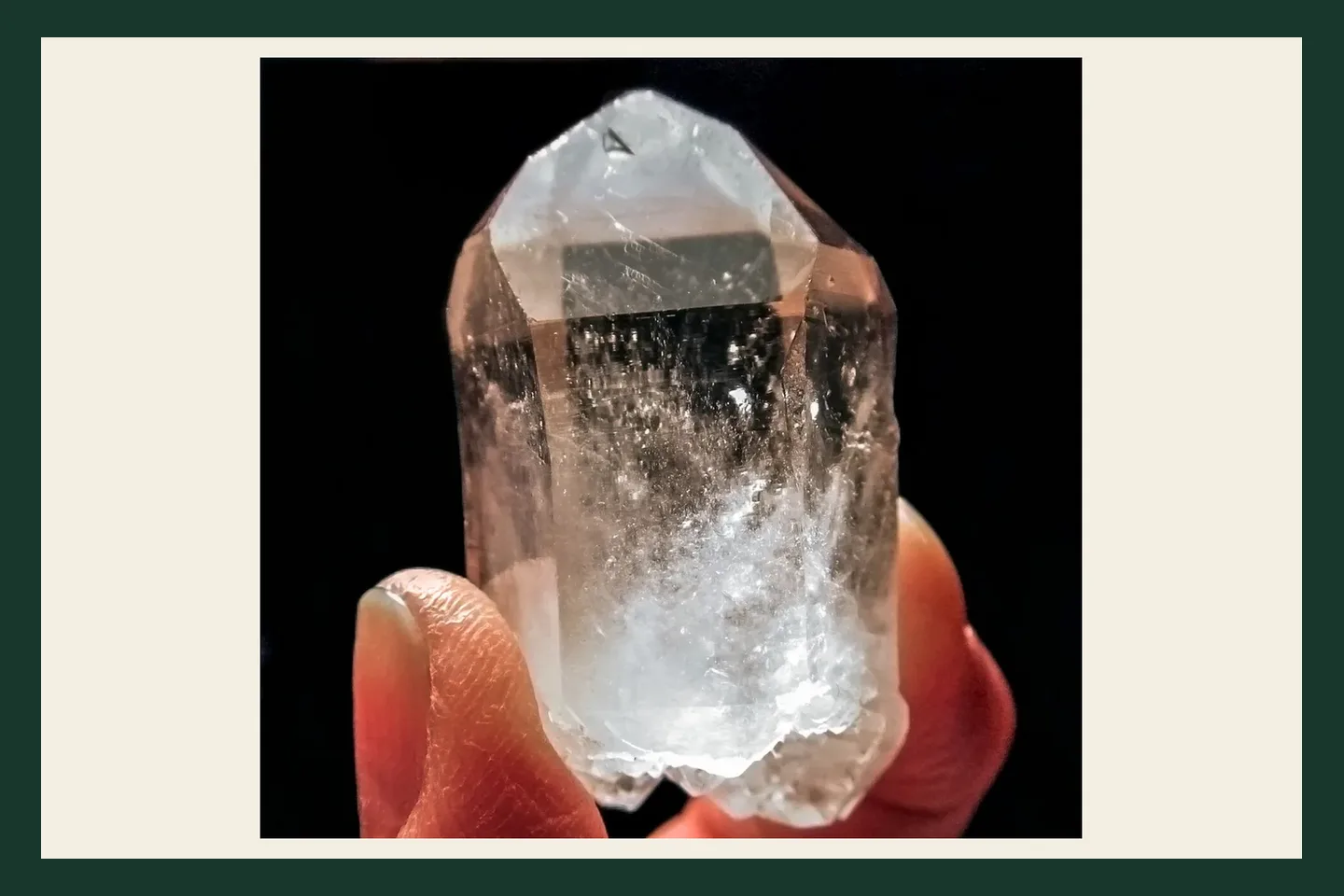
Walk into a crystal shop and you might find towering amethyst clusters, polished rose quartz hearts, clear quartz points, glittering geodes and smooth stones in almost every colour imaginable.
Walk into a crystal shop and you might find towering amethyst clusters, polished rose quartz hearts, clear quartz points, glittering geodes and smooth stones in almost every colour imaginable.
We call them all "crystals."
But scientifically, what actually makes something a crystal?
The answer isn't its colour, beauty, sparkle—or even whether it has a perfect point.
The real story is happening somewhere we can't see.
## It Starts With Atoms
Everything around us is made of atoms.
What makes a crystalline material special is the way its atoms, ions or molecules are organized.
Rather than being arranged randomly, the building blocks of a crystal are organized in an orderly three-dimensional structure. In mineral crystals, this repeating internal organization is known as the crystal structure.
Imagine creating a tiny three-dimensional pattern and repeating that organization again and again.
You wouldn't see those individual atoms when holding a piece of quartz in your hand, but that microscopic organization helps determine many of the physical properties of the material.
That internal order—not the polished shape we see in a shop—is at the heart of what makes something crystalline.
## Why Do Crystals Form Shapes?
Have you ever noticed that quartz commonly grows into elongated, six-sided forms, while pyrite may form striking cubes?
Those shapes aren't simply coincidence.
When minerals have enough space and suitable conditions to grow freely, their external forms can reflect aspects of their underlying crystal structure.
Mineralogists call the characteristic way a mineral tends to grow its crystal habit.
But here's something important:
A crystal does not have to look like a perfect crystal point to be crystalline.
Growth conditions matter.
A crystal growing deep inside rock may be crowded by neighbouring minerals. It may break. It may grow irregularly. It may later be weathered, tumbled, cut or polished.
Its beautiful textbook shape may disappear, but its underlying crystalline structure can remain.
So that smooth piece of amethyst in your pocket is still crystalline quartz even though someone polished away its natural external form.
## Crystal and Mineral Aren't Exactly the Same Word
This is where things can get confusing.
In geology, a mineral has a more specific definition. It is a naturally occurring solid formed through geological processes, with an orderly crystalline structure and a characteristic chemical composition.
Quartz is a mineral.
Amethyst is a purple variety of quartz.
Pyrite is a mineral.
Calcite is a mineral.
Minerals are also the building blocks of rocks. A rock may contain one mineral or a mixture of several minerals.
We'll explore those differences much more closely in our next article: [Crystal, Mineral, Rock or Gemstone? What's the Difference?](/articles/128)
## Crystals Can Grow
No, they aren't alive.
But crystals really can grow.
As conditions allow additional atoms or other building units to join an existing crystal structure, the crystal can become larger.
This may happen when molten material cools and crystallizes, or when dissolved substances precipitate from a solution.
Think about salt water evaporating.
As the water disappears, salt can begin forming crystals. Under suitable conditions, more material joins the developing crystal structure and the crystals grow larger.
Nature can perform versions of this process on extraordinary scales and over very different lengths of time.
## Not Everything Beautiful Is a Crystal
This is one of the most useful things to understand before exploring the crystal world.
A material can be gorgeous, shiny, colourful and prized—and still not have a crystalline internal structure.
Glass, for example, is generally amorphous. Its atoms do not have the same long-range repeating arrangement found in crystalline materials.
That is why appearance alone isn't enough to scientifically identify something as a crystal.
And it's also why a beautifully polished object sold alongside crystals isn't automatically a natural mineral crystal.
Later in this issue, we'll look at treated, dyed, synthetic and imitation materials—and how to become a more informed buyer.
## What About Clear Quartz?
Clear quartz is a wonderful example because it lets us separate what we can see from what is happening inside.
Quartz is composed of silicon and oxygen.
Those atoms are arranged in an ordered crystalline structure.
When quartz has room to develop well-formed external faces, it can produce the familiar crystal points many people recognize immediately.
But quartz doesn't have to be transparent.
Different varieties and growth conditions can give us very different-looking specimens.
Amethyst, for example, is quartz.
So is citrine.
Smoky quartz is quartz too.
They may look remarkably different, yet they belong to the same mineral family.
## Why Does Crystal Structure Matter?
Crystal structure isn't simply an interesting geological detail.
The atomic structure and chemical composition of a mineral influence physical properties scientists can observe and measure—including hardness, cleavage, density, optical behaviour and the characteristic forms in which a mineral may grow.
This is one reason mineralogists don't identify minerals by colour alone.
Colour can be useful, but appearances can be deceptive.
Two completely different minerals may look remarkably similar, while two specimens of the same mineral can look dramatically different.
Scientists therefore examine a combination of characteristics to determine what a specimen actually is.
## And Then There Is the Other Meaning of "Crystal"
Outside geology, the word crystal has taken on a much broader meaning.
In crystal shops and wellness communities, it may be used as an umbrella term for polished stones, mineral specimens, gemstones and other natural materials used for decoration, collecting, meditation, symbolism or spiritual practice.
That everyday use isn't always identical to the scientific definition.
And that's okay—as long as we understand which conversation we're having.
Throughout this issue of Elemental Reset, we'll intentionally distinguish between:
Mineralogy & Science — what can be observed, measured and studied scientifically.
History & Culture — how people and societies have valued and used particular stones.
Tradition & Spirituality — meanings and energetic associations attributed to stones within various spiritual and wellness practices.
Personal Meaning — what a particular stone represents to you.
One doesn't have to erase the others.
Understanding the geology of an amethyst doesn't prevent someone from finding it meaningful.
And appreciating the symbolism of a stone doesn't require turning that symbolism into a scientific claim.
There is room for curiosity on both sides.
## Look Again
The next time you pick up a crystal, take another look.
Notice its colour.
Its weight.
Its transparency—or lack of it.
Look for natural faces, fractures, inclusions and tiny variations.
Then remember that what you're seeing on the outside is only part of its story.
Inside is an arrangement far too small for your eyes to see—a structure built atom by atom that helps make that material what it is.
Perhaps that is one of the most fascinating things about crystals.
Their beauty isn't only on the surface.
There is structure hidden within the stone.
---
## Crystal Curiosity
Did you know?
A perfectly shaped point isn't what scientifically makes something a crystal. The defining feature is its ordered internal structure.
So a rough specimen, a broken crystal and a polished stone may still contain the same crystalline mineral—even when the familiar crystal shape is no longer visible.
## Try This
If you own a few crystals or stones, place them beside one another.
Without looking up their traditional meanings, examine them simply as natural materials.
What colours do you see?
Are they transparent, translucent or opaque?
Are they smooth or rough?
Can you see layers, fractures, inclusions or crystal faces?
For a moment, forget what the stone is "supposed" to mean.
Just observe it.
Sometimes curiosity is the best place to begin.
The central science here is well established: Smithsonian describes mineral crystals as having atoms arranged in a repeating, precise structure and explains that crystal habit can reflect underlying structure; USGS likewise defines minerals by their orderly internal structure. Smithsonian Natural History Museum