Issue #6: The Wisdom Within the Stones · Current Issue
Free article
Crystal, Mineral, Rock or Gemstone? What's the Difference?
By Dr. Constance Santego
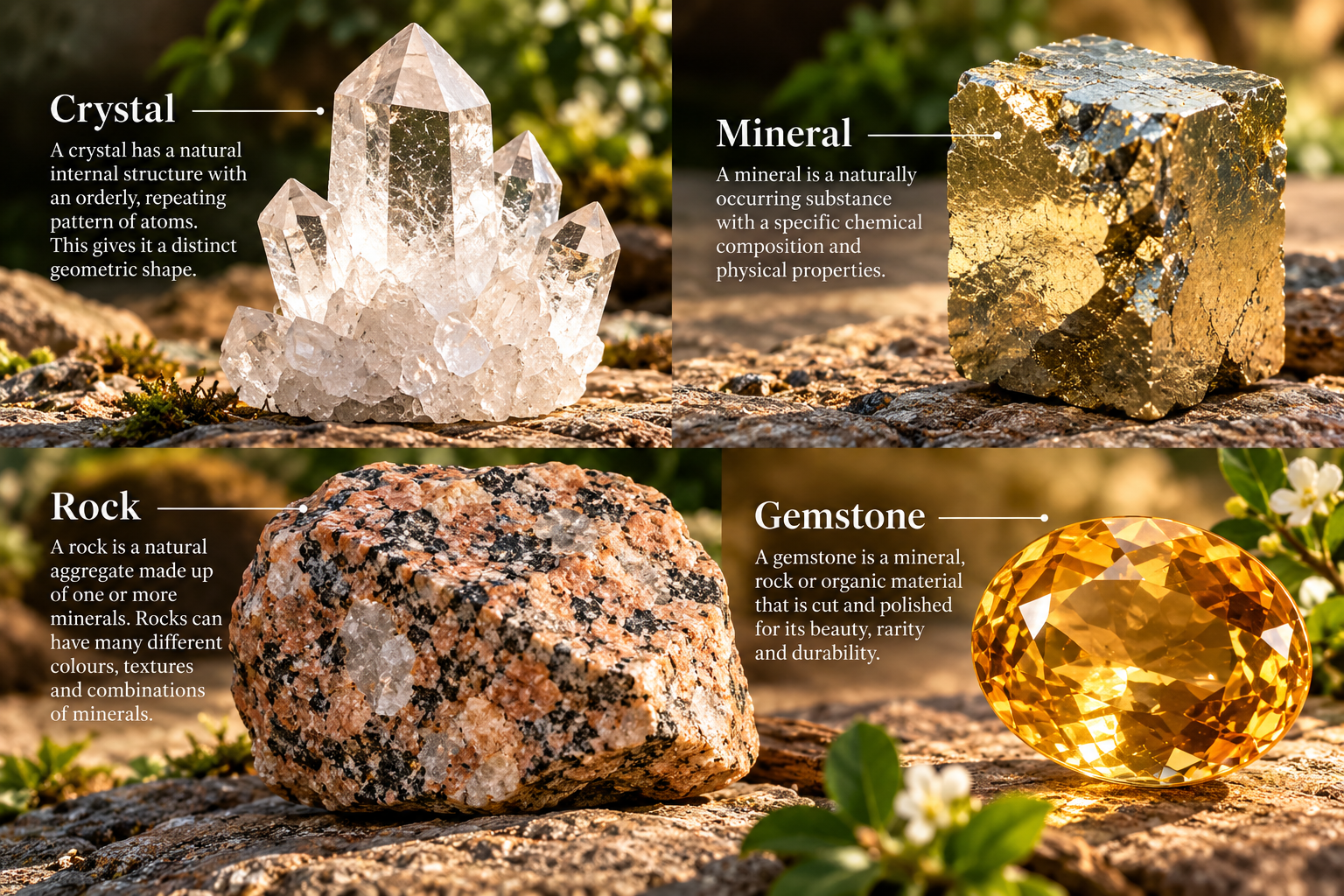
Crystal. Mineral. Rock. Gemstone.
Crystal. Mineral. Rock. Gemstone.
Walk through a crystal shop and you'll hear these words used almost interchangeably.
A piece of amethyst might be called a crystal. A polished jasper might also be called a crystal. Someone may show you a gemstone bracelet, a mineral specimen or a beautiful polished rock—and all of them may be sitting together under a sign that simply says Crystals.
So are they all crystals?
Not exactly.
These words describe overlapping—but different—things. Once you understand the distinction, the crystal world becomes much easier to navigate.
Let's sort it out.
## First: What Is a Mineral?
A mineral is a naturally occurring solid formed through geological processes with a characteristic chemical composition and an orderly internal structure.
Think of a mineral as a naturally occurring material with its own geological identity.
Examples include:
Quartz
Calcite
Fluorite
Pyrite
Hematite
Gypsum
Minerals are the basic building blocks of most rocks.
Quartz is especially important in our November issue because several stones people recognize by completely different names are actually varieties of quartz.
Clear quartz is quartz.
Amethyst is quartz.
Citrine is quartz.
Smoky quartz is quartz.
Their appearances differ because colour and other characteristics can be influenced by trace elements, defects in the crystal structure, radiation and geological conditions.
So when you hold an amethyst, you aren't holding a completely separate mineral from quartz.
You're holding a particular variety of it.
## Then What Is a Crystal?
As we explored in [Crystals 101: What Exactly Is a Crystal?](/articles/127), the scientific idea of a crystal is about internal structure.
The atoms, ions or molecules in crystalline material are arranged in an ordered three-dimensional structure.
A mineral may develop visible crystal faces when it has suitable conditions and enough room to grow.
That's where we get spectacular formations such as quartz points, cubic pyrite and fluorite crystals.
But here's the part worth remembering:
Crystal describes structure. Mineral describes a naturally occurring geological substance with particular characteristics.
The concepts overlap enormously, but the words aren't perfect synonyms.
And a crystal doesn't have to look like the stereotypical pointed crystal you might picture.
Cut it.
Polish it.
Break it.
Tumble it.
Its external appearance changes, but the crystalline material can remain.
## What Is a Rock?
Now things get bigger.
A rock is a naturally occurring solid material made up of one or more minerals—or, in some cases, mineral-like materials.
Think of minerals as ingredients.
A rock is the finished mixture.
Granite is a familiar example.
Look closely at a piece of granite and you may see different colours and textures. That's because granite commonly contains several minerals, including quartz and feldspar, often with mica or other minerals.
So granite isn't one mineral.
It's a rock made from a collection of minerals.
Geologists broadly divide rocks into three major groups:
Igneous — formed as molten rock cools and solidifies.
Sedimentary — formed through processes involving accumulated sediments, precipitation or biological material.
Metamorphic — existing rock transformed by heat, pressure and chemically active fluids without completely melting.
And yes, some materials commonly sold in crystal shops are technically rocks rather than individual minerals.
## Here's a Great Example: Lapis Lazuli
Lapis lazuli is instantly recognizable for its magnificent deep blue colour, often accompanied by golden-looking flecks.
It is frequently called a "crystal."
Mineralogically, however, lapis lazuli is a rock composed of several minerals. Lazurite is generally its major blue component, while calcite and pyrite may also be present.
Those glittering golden specks?
Often pyrite.
So calling lapis lazuli a "stone" is perfectly reasonable.
Calling it a mineral would be less accurate because it isn't a single mineral species.
And calling it a crystal in everyday crystal-shop language reflects the broader popular use of the word rather than a precise geological classification.
## Then What Makes Something a Gemstone?
This category works differently.
Gemstone is primarily a gemological and commercial designation rather than one basic geological material type.
A gemstone is a natural material valued for characteristics such as beauty, rarity and durability and used for adornment or decorative purposes.
Many gemstones are minerals.
Diamond is a mineral and a gemstone.
Ruby and sapphire are gemstone varieties of the mineral corundum.
Emerald is a gemstone variety of beryl.
Amethyst can be considered both a mineral variety and a gemstone when it is valued and used as gem material.
But not every gemstone is a mineral.
Some valued gem materials have biological origins.
Pearl, for example, is produced by certain mollusks.
Amber originates from ancient plant resin.
So "gemstone" tells us something about how humans value and use a material—not simply what geological category it belongs to.
## And What About a Stone?
Here's where we can relax a little.
Stone is a broad everyday word.
It can refer to pieces of rock, mineral material, gemstones and many other naturally occurring solid materials.
That's one reason it works so beautifully for our November theme, The Wisdom Within the Stones.
We're not claiming every object in the issue belongs to one mineralogical category.
We're exploring the remarkable natural materials humans have collected, admired and given meaning to for generations.
## Let's Make It Simple
Imagine four specimens sitting on a table.
Clear Quartz Point
Mineral? Yes — quartz.
Crystalline? Yes.
Rock? No, not when we're referring to an individual quartz crystal.
Gemstone? It can be used as gem material.
Amethyst
Mineral? It is a variety of the mineral quartz.
Crystalline? Yes.
Rock? Not when referring to amethyst quartz itself.
Gemstone? Yes, it is widely used as a gemstone.
Granite
Mineral? No — it contains minerals.
Crystalline material inside it? Yes.
Rock? Yes.
Gemstone? Generally not classified as one in ordinary gemological use.
Lapis Lazuli
Single mineral? No.
Contains minerals? Yes.
Rock? Yes.
Gem material? Yes.
Already, the display case looks a little different.
## Why Does This Matter?
You certainly don't need to become a geologist to enjoy crystals.
But knowing what you own can make collecting much more interesting.
Instead of simply asking:
"What does this crystal mean?"
you can also ask:
What is it actually made of?
Is it a mineral or a rock?
How did it form?
Where does its colour come from?
Is this its natural appearance?
Has it been cut, polished, dyed, heated or otherwise treated?
Those questions don't take the magic away.
They give the stone another story.
## The Crystal Shop Translation Guide
When you see the word crystal used in a shop, online marketplace or wellness setting, remember that it is often being used as a broad retail or cultural category.
It may include:
crystal specimens,
minerals,
rocks,
gemstones,
polished stones,
tumbled stones,
carved objects,
and occasionally materials that aren't natural stones at all.
That's why learning the actual identity of what you're purchasing matters.
A beautiful object doesn't become less beautiful because you discover it is a rock rather than a mineral.
Lapis lazuli doesn't lose its extraordinary blue colour because geology calls it a rock.
And an amethyst doesn't become more powerful because someone calls it a rare crystal rather than a variety of quartz.
Knowing what something actually is allows us to appreciate it for what it is.
## One Stone, Several Identities
Perhaps the easiest way to understand all of this is to remember that these categories can overlap.
A single specimen might be:
a mineral,
crystalline,
used as a gemstone,
and casually called a stone.
Another object may be:
a rock composed of several minerals,
polished into jewellery,
used as gem material,
and sold in a crystal shop.
The words aren't competing with one another.
They're simply describing different aspects of the material.
And once you begin seeing those differences, the world beneath your feet becomes far more interesting.
Because every stone has more than a colour.
It has a composition.
A structure.
A geological history.
And a story written long before someone placed it on a shelf.
---
## Know the Difference
CRYSTAL
Describes an ordered internal arrangement of atoms, ions or molecules.
MINERAL
A naturally occurring geological solid with an orderly internal structure and characteristic chemical composition.
ROCK
A naturally occurring solid aggregate composed of one or more minerals or mineral-like materials.
GEMSTONE
A material valued and fashioned for jewellery, ornamentation or decorative use; most are minerals, but some have other origins.
STONE
A broad everyday term that can encompass many natural solid materials.
---
## Try This
Choose three "crystals" from your own collection.
Instead of searching for their spiritual meanings, look up their mineralogical identities.
Ask:
Is it a mineral, rock or other material?
What is its chemical composition?
How did it form?
What causes its colour?
Is its current appearance natural, polished or treated?
You may discover that something you've owned for years has an entirely different story than you realized.
Sometimes knowing what you're holding makes it even more fascinating.
Because the beauty of a stone is only the beginning of its story.
Its mineral composition, crystal structure, geological formation and journey through the Earth can be just as extraordinary as the meanings we associate with it.
And the next time you walk into a crystal shop, you may find yourself looking at those beautiful displays a little differently.
Not simply wondering what a stone might do for you, but asking a more interesting question:
What exactly am I holding—and what is its story?
Sometimes the greatest discovery isn't finding another stone.
It's discovering something new about the one you already have.