Issue #6: The Wisdom Within the Stones · Current Issue
Free article
The Art of Creating a Sacred Space
You Don't Need an Entire Room. You Need Intention.
By Dr. Constance Santego
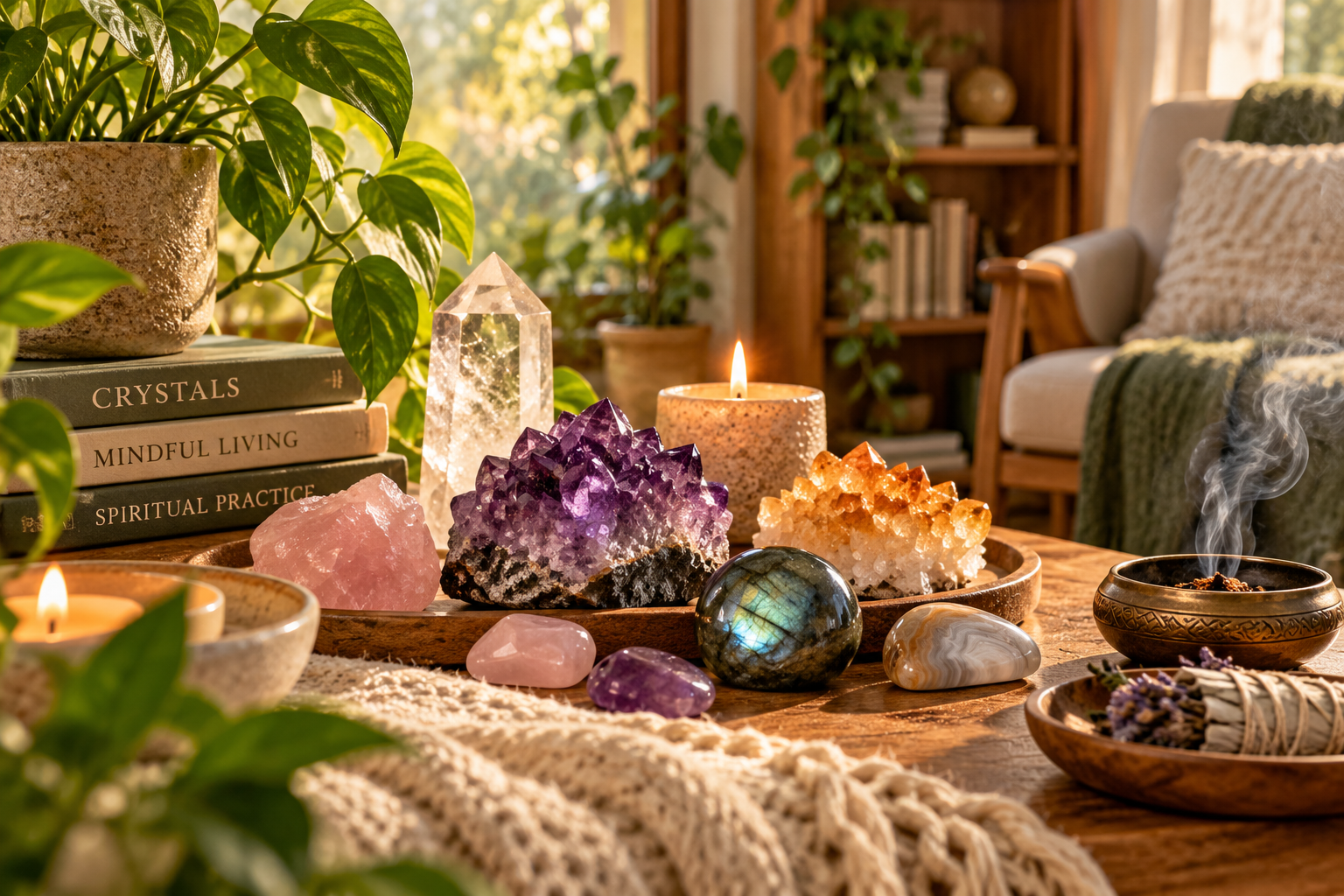
When you hear the words sacred space, what do you picture?
When you hear the words sacred space, what do you picture?
A meditation room filled with candles?
Crystals arranged perfectly on an altar?
Incense drifting through the air?
A beautiful room overlooking the mountains?
It can be any of those things.
But it doesn't have to be.
A sacred space can be one chair beside a window.
A corner of your bedroom.
A small table.
A cushion on the floor.
A garden bench.
A shelf containing a photograph and a stone you brought home from a meaningful trip.
What makes the space sacred isn't how much it costs.
It isn't how it photographs.
And it isn't whether anyone else would recognize it as sacred.
It's the intention you bring to it.
---
## What Does "Sacred" Mean to You?
The word sacred can mean different things to different people.
For some, it is connected to faith or spiritual practice.
For others, it means something deeply valued, protected or treated with reverence.
Your sacred space might be where you:
pray,
meditate,
practice Reiki,
journal,
read,
reflect,
breathe,
pull an oracle card,
sit quietly,
remember someone,
or simply spend ten uninterrupted minutes with yourself.
There is no single correct way to create one.
Before decorating anything, ask:
What do I want to experience here?
Peace?
Connection?
Clarity?
Creativity?
Prayer?
Comfort?
Reflection?
Rest?
Your answer should shape the space more than any decorating trend.
---
## Begin With a Boundary
Sacred spaces aren't created only by what we put into them.
They're also created by what we choose to keep out.
Maybe this is the one chair where you don't scroll through your phone.
Maybe work doesn't enter this corner.
Maybe the television stays off.
Maybe nobody piles laundry on this chair.
Maybe your journal stays here instead of disappearing beneath paperwork.
A boundary tells your mind:
This place is different.
It doesn't need to be rigid.
It simply needs to be intentional.
---
## Start With One Surface
You don't need to redecorate your house.
Choose one small area.
A nightstand.
A tray.
A shelf.
A corner of your desk.
The top of a dresser.
A windowsill.
Clear it completely.
Clean the surface.
Then pause before putting anything back.
Empty space is part of the design.
Instead of asking:
What can I put here?
ask:
What deserves to be here?
That question changes everything.
---
## Bring in the Elements
One beautiful way to create your space is through the symbolic language of the elements.
You don't need all of them.
Choose what speaks to you.
EARTH — Something That Grounds You
A stone.
A crystal.
A plant.
A bowl of soil.
A piece of wood.
Something collected during a walk.
Earth can represent:
stability • foundation • nourishment • presence
For our November issue, this is the perfect place for a stone that has meaning to you.
It doesn't have to be rare.
An ordinary pebble gathered somewhere special may carry more personal significance than an expensive crystal.
---
## WATER — Something That Flows
A small bowl of water.
A shell.
A photograph of the ocean.
A blue object.
Water can symbolically represent:
emotion • flow • release • intuition
If you use actual water, keep it fresh and place it somewhere safe from electronics, books and other objects that could be damaged.
Sometimes symbolism is enough.
---
## FIRE — Something That Illuminates
A candle is the obvious choice.
But fire doesn't have to mean an open flame.
Try:
a warm lamp,
soft string lights,
an LED candle,
or an object that represents transformation to you.
Fire can symbolize:
warmth • transformation • courage • illumination
If you use candles, never leave them unattended and keep flame away from fabric, dried plants, paper, oils and other flammable materials.
Sacred doesn't mean unsafe.
---
## AIR — Something That Creates Space
An open window.
A feather.
A bell.
A favourite scent.
A piece of fabric that moves with the breeze.
Air can represent:
breath • clarity • communication • spaciousness
If fragrance is part of your practice, remember that more isn't necessarily better.
Incense, essential oils and scented candles can be irritating for some people and may not be appropriate around certain pets or individuals with sensitivities.
A sacred space doesn't need a scent to be complete.
Sometimes fresh air is enough.
---
## SPIRIT — Something That Connects You
This is the most personal element.
A photograph.
A religious or spiritual symbol.
An oracle deck.
Prayer beads.
A handwritten note.
A meaningful book.
Something inherited.
An object from someone you love.
Something you created.
Spirit can represent:
meaning • connection • faith • purpose • remembrance
This is where your sacred space becomes unmistakably yours.
---
## Add a Stone With Intention
Since November is The Wisdom Within the Stones, you may want to include a crystal or stone.
Choose it differently this time.
Instead of searching:
"Which crystal should I put in my sacred space?"
ask:
"What do I want this stone to remind me of?"
Perhaps:
Clear quartz reminds you of clarity.
Amethyst represents pause.
Rose quartz represents compassion.
Smoky quartz represents grounding.
Carnelian represents action.
Or perhaps you have a completely different association.
Your meaning is allowed to be personal.
The stone isn't decorating the space simply because it's pretty.
It has a purpose.
---
## Make Room for Nothing
This may be the most overlooked part.
You don't need to fill every surface.
Sacred spaces can quickly become collections.
One crystal becomes twelve.
One candle becomes seven.
Then books arrive.
Cards.
Plants.
Statues.
Bowls.
More stones.
Eventually the peaceful corner becomes another place you have to dust.
Leave some empty space.
Let your eyes rest.
Let the objects you chose matter.
Sacred doesn't have to mean full.
---
## Think About the Senses
Now sit in the space.
Don't look at it as a decorator.
Experience it.
What Do You See?
Is the space visually calming or cluttered?
Is the lighting comfortable?
What Do You Hear?
Do you prefer silence?
Music?
Nature sounds?
A fan?
What Do You Feel?
Is the chair comfortable?
Do you need a blanket?
A cushion?
What Do You Smell?
Do you enjoy a subtle fragrance—or would you prefer clean, unscented air?
What Can You Touch?
A smooth stone?
Prayer beads?
A journal?
A soft blanket?
A sensory object can help bring attention back into the present moment.
---
## Create a Tiny Ritual
A space becomes meaningful through use, not decoration.
Choose one simple action that signals:
I'm here now.
Perhaps you:
light a candle,
turn on a particular lamp,
take three breaths,
hold a stone,
place both feet on the floor,
say a prayer,
write one sentence,
pull one oracle card,
or sit quietly for one minute.
It doesn't have to be elaborate.
In fact, the easier it is, the more likely you are to return.
---
## The Five-Minute Sacred Space
Think you don't have time?
Try this:
MINUTE 1 — ARRIVE
Put your phone down.
Sit.
MINUTE 2 — BREATHE
Take several comfortable breaths.
MINUTE 3 — NOTICE
Choose one object in your space and really look at it.
MINUTE 4 — REFLECT
Ask:
What do I need today?
MINUTE 5 — CHOOSE
Ask:
What is one intention I want to carry with me when I leave this space?
Five minutes.
That's enough.
---
## Sacred Space for Practitioners
If you work with clients, the same principles can apply to your treatment room.
Your space communicates before you say a word.
Consider:
cleanliness,
privacy,
lighting,
temperature,
sound,
accessibility,
scent,
visual clutter,
and how easily a client can understand where to place belongings and what happens next.
A practitioner space doesn't need to look overtly spiritual to feel intentional.
And remember:
your sacred objects may not be sacred to your client.
Keep the environment welcoming rather than assuming everyone shares the same spiritual beliefs.
A crystal can be beautiful.
A candle can be calming.
An oracle deck can be meaningful to you.
But your client's comfort, consent and preferences come first.
---
## What Doesn't Belong Here?
Once you've created your space, look around again.
Is anything there because you think a sacred space is supposed to have it?
A crystal you don't actually like?
Incense you never burn?
A spiritual book you feel guilty for not reading?
An object that belonged to an earlier version of you?
You are allowed to remove it.
Sacred spaces can change because you change.
Let the space evolve with you.
---
## A Sacred Space Can Travel
You may not always be at home.
Create a tiny portable version.
Perhaps a small pouch containing:
one stone,
a small card with an intention,
a photograph,
a meaningful symbol,
or something tactile.
Or skip the objects entirely.
Your portable sacred space might simply be a practice:
feet on the floor,
one slow breath,
one hand over your heart,
and one question:
What matters right now?
Your space doesn't have to surround you.
Eventually, the ritual can travel within you.
---
## Your Sacred Space Recipe
You need:
ONE PLACE
Somewhere you can return to.
ONE BOUNDARY
Something that makes this space different.
ONE MEANINGFUL OBJECT
Not because you need it—because it matters.
ONE COMFORT
A chair, cushion, blanket, light or something else that helps you settle.
ONE PRACTICE
Breathing, journaling, prayer, meditation, Reiki, reflection or stillness.
ONE INTENTION
How do you want to leave this space?
That's enough.
Everything else is optional.
---
## Try This: Create Your Space Tonight
Don't shop for anything.
Use what you already have.
Find one small surface.
Clear it.
Choose one meaningful object.
Add one comfortable place to sit, if possible.
Put your phone somewhere else.
Then spend five minutes there.
Tomorrow, return.
Not because the space itself holds some magical power.
But because you've made a quiet agreement with yourself:
When I come here, I come back to me.
Ground. Connect. Intend.
Shift Happens. Create Magic. ✨