Issue #6: The Wisdom Within the Stones · Current Issue
Free article
November's Stones: Topaz & Citrine
By Dr. Constance Santego
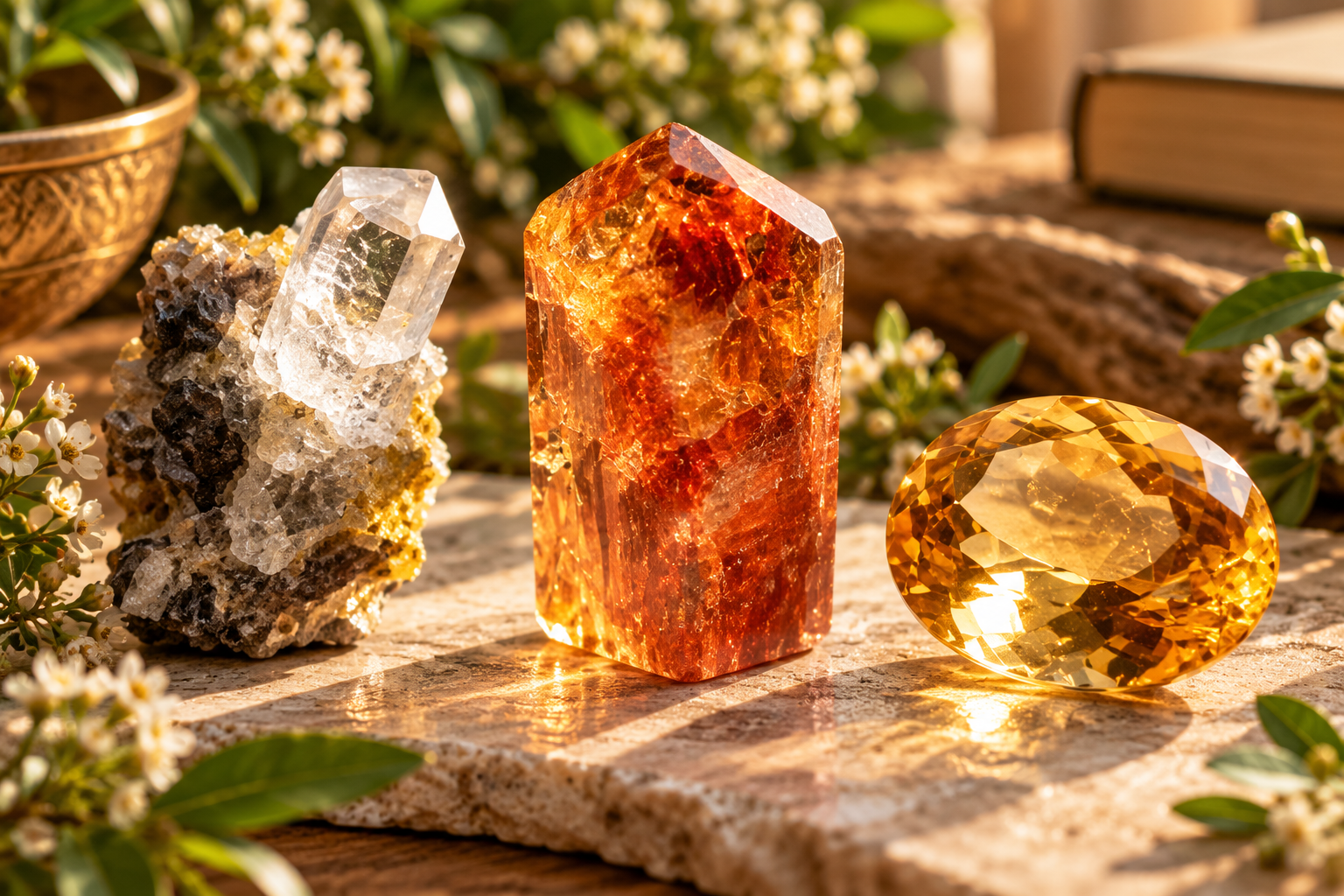
November arrives dressed in gold.
November arrives dressed in gold.
The brilliant yellow of autumn leaves.
The last warm glow before winter.
Amber light.
Honey.
Firelight.
Perhaps it is fitting, then, that November is represented by two gemstones often found in beautiful golden hues:
Topaz and Citrine.
At first glance, they can look remarkably similar.
Golden topaz.
Golden citrine.
Two warm stones for one late-autumn month.
But geologically?
They are completely different.
Different minerals.
Different chemical compositions.
Different crystal structures.
Different stories.
And that makes November's birthstones especially interesting.
---
## Why Does November Have Two Birthstones?
Birthstone traditions have changed over time.
Different cultures and historical periods have connected particular stones with months, zodiac signs and symbolic meanings.
Modern birthstone lists were later standardized and revised by jewellery-industry organizations, and today both topaz and citrine are widely recognized as November birthstones.
Having two gives November an extraordinary range.
Topaz occurs in several colours.
Citrine brings the warm yellow-to-orange palette for which it is famous.
And while modern marketing often places them side by side, their stories reach much further back.
---
## TOPAZ
More Than a Golden Stone
Say topaz and many people immediately picture yellow or golden brown.
But natural topaz can occur in several colours, including colourless, yellow, brown, pink and other hues.
Blue topaz is especially familiar in modern jewellery, although much of the vivid blue topaz in the marketplace achieves its colour through treatment.
So colour alone is not enough to identify topaz.
Mineral Identity
Mineral: Topaz
Chemical Composition: An aluminum silicate containing fluorine and hydroxyl
Crystal System: Orthorhombic
Mohs Hardness: 8
Typical Colours: Colourless, yellow, brown, pink and others; treated blue is common in jewellery
Topaz is considerably harder than quartz on the Mohs scale.
But hardness isn't the whole durability story.
Topaz has perfect cleavage in one direction, meaning it can split along particular structural planes.
So despite its hardness, it should still be protected from sharp blows.
A hard stone isn't necessarily an indestructible stone.
---
## Where Does Topaz Come From?
Topaz forms in particular geological environments, often associated with late-stage igneous processes.
It may occur in cavities within certain volcanic rocks and in pegmatites, and it can also be found in alluvial deposits after weathering releases crystals from their original host rock.
Important topaz sources have included regions of Brazil and several other parts of the world.
Some topaz crystals can grow remarkably large.
Which gives us another reminder from our earlier article, [How Crystals Are Formed Inside the Earth](/articles/138):
when chemistry, space, fluids, temperature and time align, Earth can create extraordinary mineral specimens.
---
## The Many Colours of Topaz
One of the fascinating things about topaz is how much its appearance can vary.
You may encounter names such as:
Blue Topaz
Pink Topaz
Golden Topaz
Imperial Topaz
But commercial colour names need context.
Some colours occur naturally.
Others may be produced or enhanced through treatments such as irradiation and heating.
That doesn't automatically make a treated gemstone undesirable.
Treatment is common in the gem industry.
What matters is disclosure.
A buyer should be able to understand what they're purchasing.
---
## Topaz Through History
Topaz has a long and sometimes confusing historical story.
One reason is that people in the ancient world didn't classify minerals using modern mineralogical methods.
Names were sometimes applied to stones based largely on colour or appearance.
That means a stone called "topaz" in an old text was not necessarily the mineral we identify as topaz today.
This is important whenever we talk about ancient crystal meanings.
Historical names do not always map neatly onto modern mineral species.
Rather than forcing today's definitions backward in time, it is better to acknowledge the uncertainty.
What we can say is that golden and yellow stones have fascinated people for centuries—and topaz became surrounded by traditions involving value, protection, strength and good fortune.
---
## Traditional Associations of Topaz
In modern gemstone and metaphysical traditions, topaz may be associated with ideas such as:
Joy • Confidence • Generosity • Abundance • Personal strength
Different colours of topaz may also be assigned different symbolic meanings.
These are cultural, spiritual and contemporary metaphysical associations—not scientifically established effects of the mineral.
Elemental Reset Intention
For November, let's give topaz one simple word:
VALUE
Not financial value.
Your value.
What are you undervaluing in yourself?
A skill?
An accomplishment?
Your experience?
Your time?
Your creativity?
Let topaz become the question:
What do I already possess that I need to value more fully?
---
## CITRINE
The Golden Quartz
Citrine looks as though someone captured sunlight inside quartz.
Its colours range from pale yellow to golden orange and deeper orange-brown tones.
Unlike topaz, citrine isn't its own mineral species.
It is a variety of quartz.
That means it belongs to the same mineral family as:
clear quartz,
amethyst,
smoky quartz,
and rose quartz.
Mineral Identity
Mineral: Quartz variety
Chemical Composition: Silicon dioxide (SiO₂)
Crystal System: Trigonal
Mohs Hardness: 7
Typical Colours: Pale yellow through golden yellow and orange-brown
So although citrine and yellow topaz may resemble one another, mineralogically they are quite different.
---
## Natural Citrine Is Less Common Than Many People Realize
Here is where shopping for citrine becomes interesting.
Naturally occurring citrine is comparatively uncommon.
Much of the citrine sold commercially is produced by heat-treating amethyst, which can change its colour from purple to yellow, orange or reddish-brown.
Heat-treated amethyst is still quartz.
But its colour history is different from naturally occurring citrine.
That doesn't mean it isn't beautiful.
It doesn't mean someone shouldn't own it.
And it doesn't mean it has no value.
Again, the important issue is transparency.
Know what you're buying.
---
## Citrine or Heat-Treated Amethyst?
It isn't always possible for a consumer to determine treatment simply by looking at a photograph.
Some heat-treated material displays very intense orange or burnt tones, sometimes with lighter or whitish areas.
But appearance alone isn't a perfect diagnostic test.
If natural origin matters to you, purchase from a knowledgeable seller who discloses treatments and can explain the material.
Be cautious of dramatic online claims such as:
"100% natural, never treated, extremely rare"
when no supporting information is offered.
Beautiful marketing isn't gemological evidence.
---
## Traditional Associations of Citrine
Within modern crystal and metaphysical traditions, citrine is commonly associated with:
Optimism • Confidence • Creativity • Abundance • Personal power
It is sometimes marketed as a stone that "attracts money."
That's a perfect example of where Elemental Reset takes a different approach.
A mineral doesn't need to promise financial success to become meaningful.
Elemental Reset Intention
Our November word for citrine is:
RECOGNIZE
Recognize what is already present.
Your resources.
Your relationships.
Your skills.
Your opportunities.
Your progress.
Instead of asking:
How can this stone bring abundance to me?
try:
Where is abundance already present that I haven't been noticing?
That's a very different practice.
---
## Topaz vs. Citrine
They may share November, but they aren't the same stone.
TOPAZ
Mineral: Topaz
Composition: Aluminum silicate containing fluorine and hydroxyl
Hardness: 8
Crystal System: Orthorhombic
November Intention: VALUE
CITRINE
Mineral: Quartz variety
Composition: Silicon dioxide
Hardness: 7
Crystal System: Trigonal
November Intention: RECOGNIZE
Two golden stones.
Two completely different mineral identities.
---
## Which One Are You Drawn To?
Forget the birthstone rules for a moment.
Look at both.
Topaz.
Citrine.
Which catches your attention?
Then ask why.
The colour?
Clarity?
Shape?
History?
Rarity?
The meaning we've given it?
Or simply because you think it's beautiful?
There doesn't have to be a deeper explanation.
Sometimes beauty is enough.
---
## If November Is Your Birth Month...
You don't have to choose between them.
You can appreciate both.
And you certainly aren't required to wear your birthstone.
Birthstones are traditions—not prescriptions.
If November's stones mean something to you, wonderful.
If you've never felt particularly connected to either one, that's fine too.
Personal meaning isn't assigned by a calendar.
---
## Caring for Topaz & Citrine
Although both stones are relatively hard, they still deserve thoughtful care.
Topaz
Topaz is hard but has perfect cleavage, so protect it from sharp impacts.
Avoid assuming that high hardness means it cannot break.
Citrine
Citrine has the same basic hardness as other quartz varieties.
Protect jewellery from hard knocks and abrasive contact.
Prolonged exposure to intense heat or strong light may affect the colour of some quartz material, so thoughtful storage is sensible.
For Both
When you're unsure how a gemstone has been treated or what cleaning method is appropriate, choose the gentlest option and ask a qualified jeweller or gem professional before using ultrasonic, steam or chemical cleaning methods.
---
## November Reflection
November sits between abundance and quiet.
The harvest season is ending.
The days grow shorter.
The natural world begins pulling inward.
And perhaps our two November stones offer an interesting pair of questions.
TOPAZ — VALUE
What have I accomplished, learned or become that I haven't given myself enough credit for?
CITRINE — RECOGNIZE
What is already present in my life that I've stopped noticing?
One asks us to recognize our own worth.
The other asks us to recognize what we already have.
Neither requires a gemstone to answer.
But sometimes a beautiful object gives us a reason to stop long enough to ask.
---
## Try This: November's Two-Stone Reflection
Take a page in your journal.
Divide it in half.
On the left write:
VALUE
List five things about yourself, your work, your growth or your experience that deserve more recognition.
On the right write:
RECOGNIZE
List five things already present in your life that you appreciate.
Then look at the page.
Ten things.
Already there.
Perhaps November's greatest abundance isn't about attracting more.
Perhaps it's about finally seeing the value in what has already arrived.
Value what you carry.
Recognize what you have.
Ground. Connect. Intend.
Shift Happens. Create Magic. ✨