Issue #5: The Healing Power of Sound · Current Issue
Free article
The Sound That Summoned the Spirits
Ancient Bullroarers, Healing Rituals & the Mysterious Power of the Unseen Voice
By Dr. Constance Santego
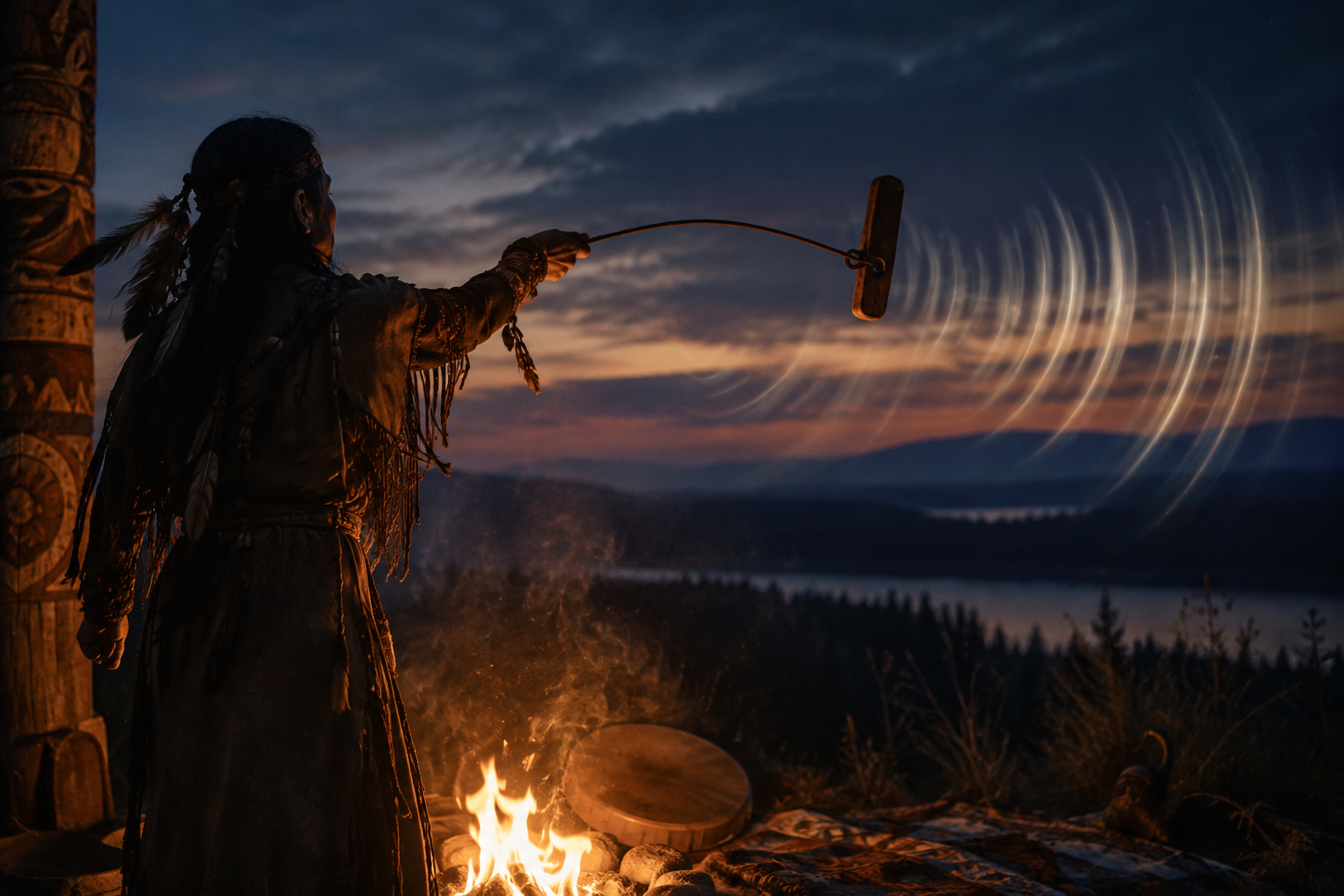
An atmospheric look at ancient bullroarers, ritual sound, archaeological mystery, and why unfamiliar sounds can make the unseen feel close.
Long before singing bowls filled wellness studios and sound baths became popular, humans were creating sounds that seemed almost impossible to explain. One of the strangest was produced by an extraordinarily simple instrument: a thin piece of wood, bone, or stone attached to a cord. Swing it through the air and something remarkable happens. It begins to speak—not with words, but with a deep, pulsating roar that rises, falls, trembles, and seems to move through the darkness. Today we call this instrument a bullroarer. But to people who heard its mysterious voice centuries or even thousands of years ago, the sound could represent something much more powerful.
<h2>A Voice Without a Body</h2>
<p>Imagine standing outside at night.</p>
<p>There are no engines. No electrical hum. No speakers. No recorded music.</p>
<p>Then, somewhere beyond the firelight, a low vibrating sound begins.</p>
<p><em>Wooooom… wooooom… wooooom…</em></p>
<p>It grows louder.</p>
<p>Then softer.</p>
<p>It appears to move through the air.</p>
<p>Yet you cannot see where it is coming from.</p>
<p>For people living before modern acoustics could explain the phenomenon, a sound like this could easily seem otherworldly.</p>
<p>In different cultures, bullroarers became associated with ceremonial life, sacred beings, ancestors, spirits, initiation, and communication with unseen realms.</p>
<p>In some documented traditions, bullroarers were also associated with healing practices.</p>
<h2>Could Sound Frighten Illness Away?</h2>
<p>For much of human history, illness was not always understood as purely physical.</p>
<p>Depending upon the culture and time period, sickness might be interpreted as an imbalance, spiritual disturbance, intrusion, loss of vital force, influence of an ancestor or spirit, or disruption between the individual and the surrounding world.</p>
<p>Healing therefore could involve more than plants or physical treatments.</p>
<p>It could involve sound.</p>
<p>Drums could be beaten. Voices could chant. Rattles could shake. Bells could ring.</p>
<p>And strange instruments could produce sounds intended to transform the atmosphere surrounding the person being healed.</p>
<p>Among some Indigenous peoples documented by ethnographers, bullroarers were attributed ceremonial or curative properties.</p>
<p>That does not mean every culture used the instrument for healing—or that ancient people all shared the same beliefs.</p>
<p>Quite the opposite.</p>
<p>The bullroarer appears in different cultures around the world, and its meaning depended upon the people using it.</p>
<p>But its repeated connection with ritual raises a fascinating question:</p>
<p><strong>Why did humans repeatedly turn to unusual sounds when confronting illness, fear, and the unknown?</strong></p>
<h2>An Instrument Thousands of Years Old</h2>
<p>Objects capable of producing bullroarer-like sounds appear deep in the archaeological record.</p>
<p>Some prehistoric objects have been interpreted as possible bullroarers, including a remarkable bone object discovered in Denmark dating back approximately 8,500 years.</p>
<p>We cannot know exactly why its maker created it.</p>
<p>Perhaps it was musical.</p>
<p>Perhaps ceremonial.</p>
<p>Perhaps practical.</p>
<p>Perhaps something entirely different.</p>
<p>Archaeology can reveal the object.</p>
<p>It cannot always recover the story that surrounded it.</p>
<p>And that uncertainty may be the most haunting part of all.</p>
<p>Someone thousands of years ago held that object.</p>
<p>Someone tied it to a cord.</p>
<p>Someone swung it through the air.</p>
<p>And someone listened.</p>
<h2>Why the Sound Feels So Strange</h2>
<p>The mystery of the bullroarer does not require anything supernatural.</p>
<p>Its eerie effect has a physical explanation.</p>
<p>As the instrument travels through the air, it also rotates around its own axis. Those movements disturb the surrounding air and create changing sound waves.</p>
<p>The result is a powerful fluctuating tone.</p>
<p>Its volume and pitch can shift.</p>
<p>The sound seems to pulse.</p>
<p>It can travel considerable distances.</p>
<p>And because the instrument itself may be difficult to see, the listener hears a powerful moving sound without an obvious source.</p>
<p>Our ancestors may not have understood the aerodynamics.</p>
<p>But they certainly understood the effect.</p>
<h2>Sound Changes the Experience of a Space</h2>
<p>There is another reason these instruments may have felt powerful.</p>
<p>Sound does more than enter our ears.</p>
<p>It changes our perception of the environment around us.</p>
<p>A drumbeat in daylight can feel musical.</p>
<p>The same drumbeat echoing through a dark forest can feel completely different.</p>
<p>A whisper in your kitchen is ordinary.</p>
<p>A whisper inside a cave can become unsettling.</p>
<p>Context changes sound.</p>
<p>And sound changes context.</p>
<p>That relationship may help explain why sound became such an important part of ritual across human cultures.</p>
<p>Sound could signal that ordinary life had stopped and something different was beginning.</p>
<p>A ceremony. An initiation. A healing. A prayer. A journey into the unknown.</p>
<h2>From Ancient Ritual to Modern Sound Healing</h2>
<p>Modern sound healing looks very different from ancient ceremonial practices.</p>
<p>Today practitioners may use singing bowls, gongs, tuning forks, drums, chimes, humming, chanting, or recorded frequencies.</p>
<p>The explanations have changed too.</p>
<p>Modern researchers can investigate how rhythm, music, vibration, breathing, and auditory stimulation affect relaxation, attention, emotion, and the nervous system.</p>
<p>But perhaps one ancient observation remains surprisingly familiar:</p>
<p><strong>Sound changes how we feel.</strong></p>
<p>Our ancestors discovered that long before anyone could measure brain waves or nervous-system responses.</p>
<p>They simply listened.</p>
<h2>The Halloween Question</h2>
<p>Tonight, if you heard a strange pulsing roar moving through the darkness outside your home, would you recognize an ancient instrument?</p>
<p>Or would some older part of your brain whisper:</p>
<p><em>Something is out there.</em></p>
<p>Perhaps that is part of sound's enduring mystery.</p>
<p>We do not simply hear sound.</p>
<p>We interpret it.</p>
<p>We feel it.</p>
<p>We search for its source.</p>
<p>And when we cannot find one, imagination steps into the darkness.</p>
<h2>Elemental Reflection</h2>
<p>Close your eyes for a moment and notice the sounds around you.</p>
<p>Which sounds make your body soften?</p>
<p>Which make you alert?</p>
<p>Which make you curious?</p>
<p>And which sounds make you uncomfortable before you even understand why?</p>
<p>Sometimes the body's response to sound begins before the conscious mind has decided what the sound means.</p>
<p>Perhaps the oldest healing instrument was never the bullroarer, drum, bell, or human voice.</p>
<p>Perhaps it was our ability to listen.</p>
<aside><strong>Editorial note:</strong> Historical uses of sound should be presented within their cultural contexts. References to spirits, ancestors, supernatural beings, and healing describe historical or cultural beliefs and should not be interpreted as evidence that sound can cure disease or remove supernatural entities.</aside>
Perhaps the oldest healing instrument was never the bullroarer, drum, bell, or human voice. Perhaps it was our ability to listen.