Issue #4: The Strength Within · Archived Issue
Free article
Building & Maintaining Muscle
Why muscle matters more as men age — and how strength supports movement, metabolism, independence, and everyday life
By Dr. Constance Santego
Why muscle matters more as men age — and how strength supports movement, metabolism, independence, and everyday life.
Muscle is about far more than appearance. As men age, maintaining strength supports everyday movement, metabolic health, independence, and the ability to keep participating fully in life.
Muscle of the Month format. Include an anatomy section, functional movement section, age-related muscle section, practical strength section, and a simple reader self-check.
Do not prescribe individualized exercise or rehabilitation for injuries. Make it educational and encourage professional assessment when pain, weakness, balance problems, or functional decline are significant.
Use the following article copy:
Muscle of the Month
Building & Maintaining Muscle
Why muscle matters more as men age — and how strength supports movement, metabolism, independence, and everyday life
When we think about men's muscles, it's easy to picture the visible ones.
Biceps.
Chest.
Shoulders.
The muscles we associate with looking strong.
But some of the most important muscles in a man's body aren't important because of how they look.
They're important because of what they allow him to keep doing.
Getting out of a chair.
Climbing stairs.
Working.
Walking.
Lifting.
Maintaining balance.
Getting down on the floor—and back up again.
Playing with children or grandchildren.
Continuing to participate in life.
This month, we're looking at muscle differently.
Not as decoration.
Not as proof of masculinity.
But as an important part of healthy aging and functional independence.
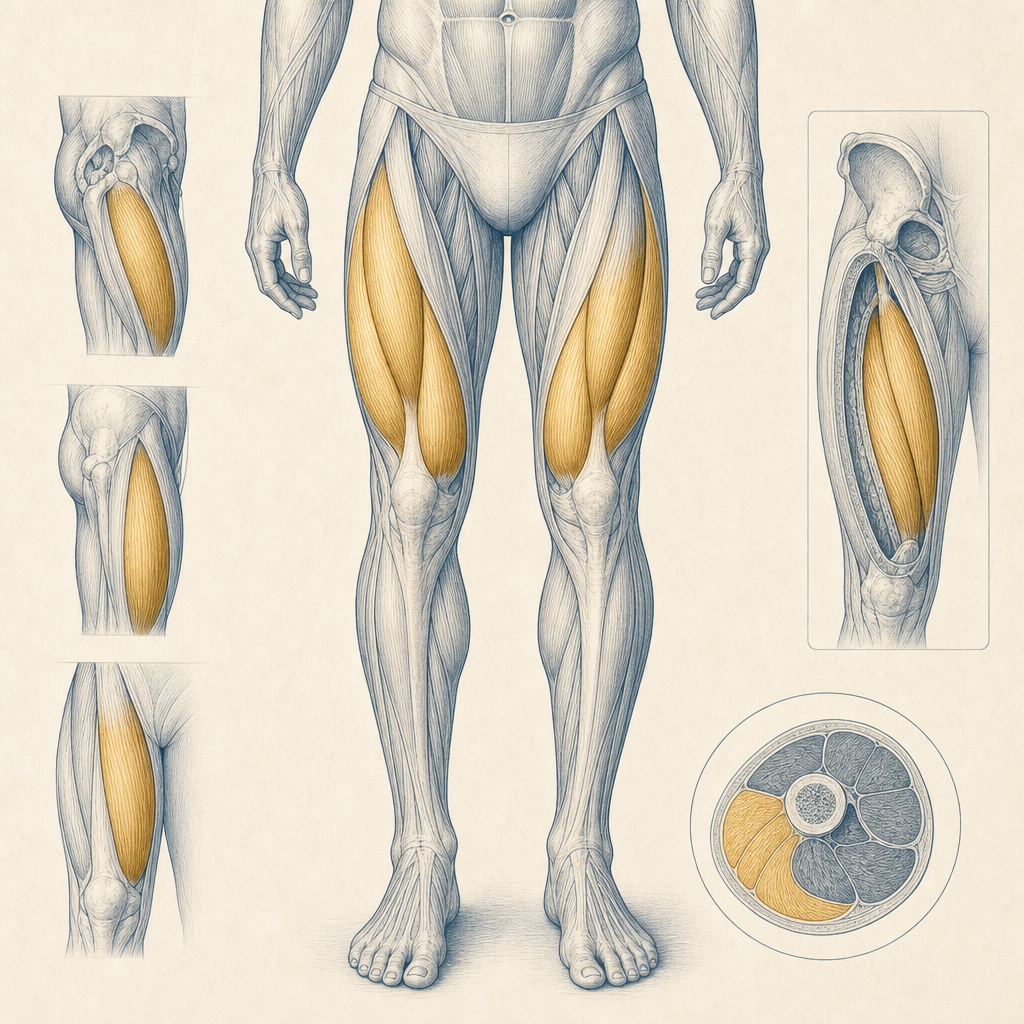
## Featured Muscle: The Quadriceps
The quadriceps are the large group of muscles on the front of the thigh.
Despite the common shorthand of calling the quadriceps “one muscle,” the group contains four:
Rectus femoris
Vastus lateralis
Vastus medialis
Vastus intermedius
Together, they are powerful extensors of the knee.
That means they help straighten the knee—a movement required repeatedly throughout everyday life.
The rectus femoris also crosses the hip joint and assists with hip flexion.
## Why Your Quadriceps Matter
Stand up from a chair without using your hands.
Your quadriceps just worked.
Climb a staircase.
They work again.
Lower yourself into a chair.
Your quadriceps help control the descent.
Walk uphill.
Get out of the car.
Squat down to pick something up.
Rise from the floor.
The quadriceps participate again and again.
This is why maintaining leg strength becomes about much more than exercise performance.
Strong legs help preserve options.
## Muscle Changes As We Age
Muscle mass and strength can gradually decline as we get older, particularly when physical activity decreases.
Age-related loss of skeletal muscle mass and function is often discussed under the term sarcopenia.
But aging doesn't mean that becoming progressively weak is inevitable.
Resistance exercise remains one of the most important ways older adults can challenge and maintain muscular strength and physical function.
The question therefore doesn't need to be:
> “Can I still look like I did when I was 25?”
A far more useful question is:
> “What do I want my body to still be able to do when I'm 65, 75 or 85?”
## Muscle Is More Than Strength
Skeletal muscle isn't only responsible for movement.
It also plays an important role in metabolic health.
Muscle tissue uses glucose, and physical activity can improve the body's ability to manage blood glucose.
Maintaining muscle also supports physical capacity, mobility and the ability to remain active—which in turn influences many other aspects of health.
This is another reason strength training shouldn't be viewed solely as bodybuilding.
You don't need to want large muscles to benefit from healthy muscles.
## The “Use It or Lose It” Idea Needs One Addition
We've all heard:
Use it or lose it.
There is truth in that idea.
But perhaps a better version is:
> Use it appropriately—and keep giving it a reason to stay.
Muscle responds to challenge.
If the body is never asked to push, pull, lift, carry, squat or resist force, it has less reason to maintain the same capacity.
That challenge does not have to mean extreme workouts.
Resistance can come from:
- body-weight exercises
- resistance bands
- free weights
- machines
- carrying appropriate loads
- climbing stairs
- functional strength exercises
- physically demanding recreational activities
The appropriate starting point depends on the individual.
## Strength Training Isn't Just for Young Men
One of the most persistent misconceptions is that strength training belongs to young people.
In reality, maintaining strength may become more important, not less, as we age.
The goal simply changes.
At twenty-five, someone may train because they want to lift more.
At fifty-five, they may want to keep doing demanding work comfortably.
At seventy-five, the goal may be getting up from a chair easily, carrying groceries, maintaining balance and travelling independently.
Different goal.
Same underlying principle:
> Keep giving the body an appropriate reason to remain capable.
## Don't Forget Recovery
Muscle isn't built during the exercise itself.
Exercise provides the stimulus.
The body then needs adequate recovery and nutrition to adapt.
That means more isn't automatically better.
Training hard every day while sleeping poorly, eating inadequately and never allowing recovery isn't necessarily a better strength strategy.
This connects directly with another feature in our September issue:
Sleep, Stress & Recovery.
Strength requires both challenge and restoration.
## Protein Matters—But It Isn't Magic
Protein provides amino acids used by the body to build and repair tissues, including muscle.
But protein powder alone doesn't create strong muscles.
Neither does one particular food.
Building and maintaining muscle involves the larger picture:
appropriate resistance exercise + adequate nutrition + recovery + consistency.
Individual protein requirements vary according to factors such as body size, age, activity level and health status. People with medical conditions affecting nutritional needs should seek individualized guidance rather than following a generic high-protein plan.
## Everyday Strength Counts
You don't need to become a bodybuilder.
Think about the movements your life actually requires.
Can you:
- Get out of a chair without pushing yourself up with your arms?
- Climb a flight of stairs comfortably?
- Carry your groceries?
- Lift something from the floor using good control?
- Walk at a comfortable pace?
- Get down onto the floor and return to standing?
- Maintain your balance while dressing?
- Carry something moderately heavy for a short distance?
These aren't gym competitions.
They are measures of everyday capability.
<div style="border:1px solid rgba(25,79,82,.25);background:rgba(245,240,229,.7);padding:1.25rem 1.5rem;margin:2rem 0;border-radius:8px">
<h2>Try the Chair Awareness Check</h2>
<p>Use a stable chair that will not slide.</p>
<p>Sit normally with your feet comfortably positioned.</p>
<p>If it is safe for you, notice what happens when you stand.</p>
<ul>
<li>Do you need your hands?</li><li>Do you rock forward several times?</li><li>Does one leg seem to do most of the work?</li><li>Is there pain?</li><li>Do you feel unstable?</li>
</ul>
<p>Then sit down again slowly and notice whether you can control the descent rather than dropping into the chair.</p>
<p>This is not a diagnostic test.</p>
<p>It is simply an opportunity to notice how an everyday movement feels.</p>
<p>If standing from a chair has become significantly difficult, painful, or unstable, consider discussing the change with an appropriate healthcare or rehabilitation professional.</p>
</div>## What About the Upper Body?
Upper-body strength matters too.
So do the back, hips, core, calves, hamstrings, shoulders and arms.
A well-designed resistance program trains the body as a system.
We're highlighting the quadriceps this month because they demonstrate something important:
The muscles that help determine how independently we move through life aren't necessarily the ones we notice in the mirror.
## Start Where You Are
If you haven't exercised for years, you don't have to prove anything on your first day back.
You don't need to lift what you lifted twenty years ago.
And you don't need to compare yourself with the person beside you.
The useful starting point is simply:
What can my body safely do today?
Then build from there.
Small amounts of appropriate resistance performed consistently can be far more useful than an overly ambitious program abandoned after two weeks.
## Building Muscle Is Really About Building Capacity
Perhaps we should stop talking about muscle only in terms of size.
Build the capacity to climb.
Build the capacity to carry.
Build the capacity to work.
Build the capacity to travel.
Build the capacity to recover from a stumble.
Build the capacity to remain independent.
Build the capacity to continue participating in the life you have created.
Because eventually, the most impressive thing about strong legs isn't how they look.
It's where they can still take you.
## Wellness & Exercise Disclaimer
This article provides general educational information and is not individualized exercise, rehabilitation, nutritional, or medical advice. People with pain, significant weakness, balance difficulties, recent injuries, cardiovascular concerns, or medical conditions that may affect exercise should consult an appropriate qualified healthcare professional before beginning or substantially changing an exercise program.
Eventually, the most impressive thing about strong legs isn't how they look. It's where they can still take you.